Natural Gas Safety After an Earthquake: What Bay Area Homeowners Need to Know
If you live in the Bay Area, earthquake preparedness likely includes an emergency kit, water supply, and maybe straps on the bookshelf. What most homeowners overlook is the gas system. About one in four fires following a major earthquake is caused by a natural gas leak — not by structural collapse. This article explains why gas lines fail during seismic events, what a seismic gas shutoff valve does and how to get one installed, and what a proper post-earthquake gas inspection covers. If you have a gas meter and no automatic shutoff valve, this is worth reading before the next event.
Why Gas Lines Fail During Earthquakes
Natural gas pipes in residential homes are typically black iron or galvanized steel — materials chosen for strength and durability under normal conditions. The problem is that these materials are rigid. They resist bending but do not absorb movement. When the ground shifts during a seismic event, the pipes are forced to move with the structure while remaining connected to fixed points underground. That differential movement is where failures occur.
The California Seismic Safety Commission identifies three primary conditions that increase the risk of gas-related fire after an earthquake: structural weaknesses in the building, gas appliances that are not anchored, and the absence of flexible pipe connections at appliance hookups.
The Most Vulnerable Points in a Residential Gas System
Not every part of the gas system fails equally. Damage concentrates at the points where rigid pipe meets a fixed connection or where a heavy appliance moves independently of the wall.
- The meter connection: where the utility's line meets your home's house line. Any lateral shift at the foundation puts direct shear force on this joint.
- Threaded elbows and unions inside walls and crawl spaces: threaded connections can unscrew or crack under torsion. These are rarely visible and often go undetected after minor events.
- Appliance flex lines: the corrugated stainless connectors behind stoves, dryers, and water heaters. If a heavy appliance slides even a few inches during shaking, the flex connector can pull apart or kink, releasing a full-pressure gas stream into the room.
- Slab penetrations and underground transitions: in Bay Area homes built on expansive clay soil, ground movement at the foundation-to-slab interface can stress gas lines at entry points.
A water heater that is not strapped to the wall is a particular hazard. It is heavy, top-loaded, and sits on a hard floor. If it tips, it can simultaneously rupture the gas line, break the cold water inlet, and knock out the vent connection — three failure points at once.
Seismic Gas Shutoff Valves: How They Work and How to Get One Installed
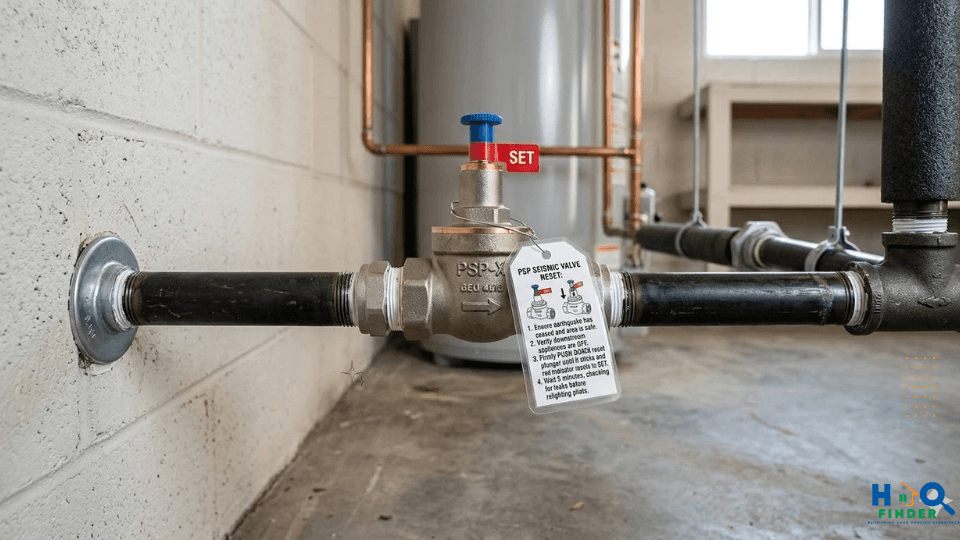
A seismic gas shutoff valve — also called an earthquake shutoff valve or seismic valve — is a passive safety device installed on your gas line that automatically blocks gas flow when ground shaking exceeds a set threshold. It requires no power, no action from the homeowner, and no network connection. It works whether you are home, asleep, or away.
How the Valve Works
Inside the valve body, a small metal ball sits in a shallow cradle above the gas flow path. When vibration from an earthquake reaches a sufficient magnitude — typically corresponding to a 5.1 or greater event at the installation site — the ball is displaced from its cradle. It drops into the seat of the valve, physically blocking gas flow. The valve stays closed until it is manually reset by a qualified professional.
The mechanism is entirely mechanical. There are no electronics, no batteries, and no moving parts that require periodic replacement under normal conditions. The valve either trips or it does not.
Where the Valve Must Be Installed
Under California Public Utilities Commission regulations (General Order 112-E), seismic shutoff valves must be installed on the customer's house line — the piping on your side of the gas meter. Installation on PG&E's or SoCalGas's facilities is not permitted and any unauthorized valve found on utility infrastructure will be removed.
The house line begins at the last elbow or tee connecting to the utility's meter. Your licensed plumber installs the valve on your side of that connection, as close to the meter as practical. In most Bay Area single-family homes, this is a straightforward installation that requires shutting off gas service temporarily.
What Installation Involves
Installation requires a licensed plumber — not a general contractor and not a handyman. The work involves cutting into the existing gas line, threading or welding the valve body into the line, pressure-testing the connection, and coordinating gas shutoff and restoration with the utility. In most jurisdictions, a permit is required.
After installation, PG&E (or your local utility) can send a technician to verify the installation is correct and perform a complimentary safety check on gas appliances. This step is worth requesting. It confirms the valve is on your house line, not on utility property, and that all appliances re-light properly after service restoration.
Local Requirements and Real Estate Transactions
Several Bay Area cities and counties have adopted ordinances requiring seismic gas shutoff valves at the time of sale or during significant renovation permits. Requirements vary by jurisdiction. In Los Angeles, ordinances have been in place since the early 2000s. In the South Bay and Peninsula, requirements vary by city. If you are buying or selling a home in Sunnyvale, Mountain View, Santa Clara, Palo Alto, or surrounding communities, verify current local requirements with the building department before closing.
Some homeowner's insurance carriers offer premium discounts for documented seismic valve installation. The valve itself typically costs $150-400 depending on line size and type. Installed cost with labor and permit varies by location and site conditions but generally falls in the $300-600 range for a standard residential installation.
| Valve Type | How It Activates | Best For |
|---|---|---|
| Seismic (shake-actuated) | Ball drops when shaking exceeds threshold (~5.1 magnitude) | All residential gas meters — primary recommendation |
| Excess flow valve (EFV) | Closes when flow rate spikes beyond normal range | Underground service lines — protects against excavation damage |
| Methane detector / hybrid | Electronic sensor triggers shutoff on gas detection | High-risk areas; adds active monitoring layer |
Excess flow valves (EFVs) protect against a different failure mode — a severed underground line caused by digging or construction, not earthquake shaking. Installation of an EFV is coordinated through your utility and costs $2,500-$5,000 or more depending on site conditions. They do not replace seismic shutoff valves; the two address different risks.
Manual Gas Shutoff: What to Do and When
A seismic valve handles the scenario where you are not present or not alert. Manual shutoff handles the scenario where you are present, something feels wrong, and you need to act before the valve trips on its own — or in a home that does not yet have an automatic valve installed.
When to Shut Off the Gas Manually
The California Seismic Safety Commission is specific on this point: shut off the gas only if you have a concrete reason to believe there is a leak or damage. Do not shut off the gas as a precaution after every tremor. Unnecessary shutoffs create two problems: you lose gas service to appliances including heating, and restoration requires a utility technician or licensed plumber — which after a major event can mean days or weeks of delays due to high demand.
Shut off the gas manually if you:
- Smell the distinctive odor of natural gas (a sulfur or rotten egg smell added by the utility)
- Hear a hissing or rushing sound near gas lines, the meter, or appliances
- See visible damage to gas pipe, the meter, or flex connectors behind appliances
- Have confirmed structural damage to the building that may have affected embedded gas lines
How to Shut Off the Gas at the Meter
- Go to your gas meter. In most Bay Area homes it is on the exterior wall, often on the side of the house facing the street or driveway.
- Locate the shutoff valve on the pipe just before the meter. It is a rectangular or flat nub on the pipe body.
- Use an adjustable wrench or dedicated gas shutoff wrench to turn the valve a quarter turn. When the valve handle is perpendicular (crosswise) to the pipe, gas flow is stopped.
- Do not attempt to turn the gas back on yourself. Once off, restoration requires inspection by a utility technician or licensed plumber.
Keep a wrench accessible near the meter — not inside the house where you may not be able to reach it after a major event. A dedicated gas shutoff wrench hung on a hook near the meter is a simple, permanent solution. Make sure every adult in your household knows where the meter is and what the shutoff valve looks like.
Post-Earthquake Gas Line Inspection: What It Covers and Why It Matters
This is the part of earthquake gas safety that most homeowners skip. The ground shakes, nothing obviously breaks, the lights come back on, and life continues. But gas line damage after an earthquake is frequently invisible from the surface. Threaded connections that have partially loosened, flex lines that have kinked internally, and micro-fractures at slab penetrations do not announce themselves with a smell or a sound — not immediately.
A post-earthquake gas inspection by a licensed plumber uses pressure testing to detect exactly these conditions before they become a leak large enough to be noticed.
What a Pressure Test Involves
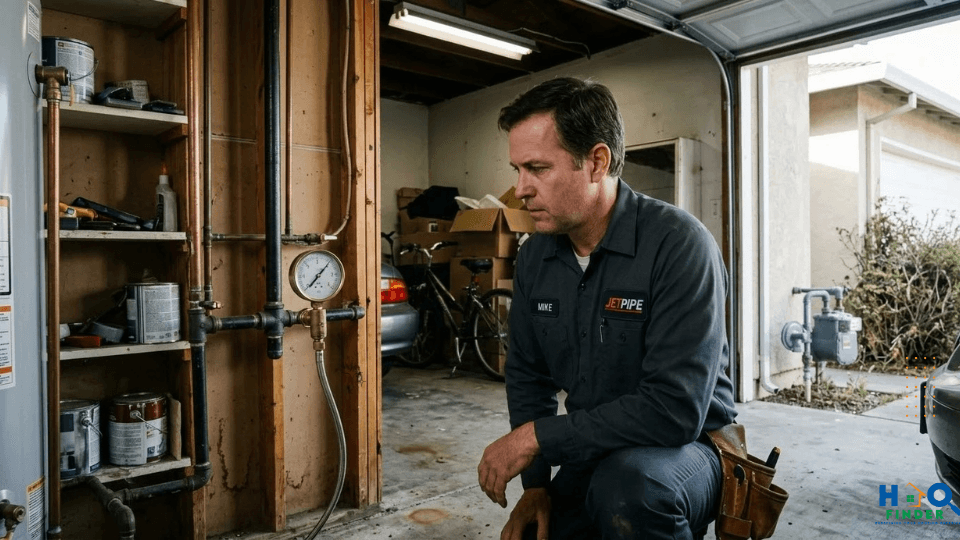
The plumber isolates your home's gas system from the utility supply and pressurizes the house line with air or inert gas — not natural gas. A calibrated pressure gauge is attached to the system. If the needle holds steady over the test period, the system is intact. If it drops, there is a leak somewhere in the system. The plumber then works through the line section by section, using an electronic gas sniffer or soap solution at joints, to locate the source.
This is the same procedure required before gas service is restored after a seismic valve trip. If you call a licensed plumber after your seismic valve activates, they will not simply reset the valve and turn the gas back on — they will perform this test first.
When to Schedule an Inspection
An immediate post-earthquake inspection is warranted if your seismic valve tripped, if you manually shut off the gas due to a suspected leak, or if the event was a 5.5 magnitude or greater measured at your location. For smaller events, the practical guidance from the USGS is that once gas has been shut off, it should only be restored by a qualified professional following inspection.
An annual gas line inspection is a reasonable practice for Bay Area homeowners regardless of seismic activity. Older homes — particularly those built before 1980 with original black iron gas piping — can develop micro-leaks at threaded unions that have vibrated loose over decades of minor tremors. These are not detectable by smell at the levels they initially present, but they are detectable with a gas sniffer run through the attic, crawl space, and behind appliances.
What the Inspection Covers
- Pressure test of the full house line from the meter to all appliance connections
- Visual inspection of all accessible gas pipe runs in the attic, crawl space, and garage
- Electronic leak detection at all threaded unions, elbows, and appliance connections
- Inspection of flex connectors at water heater, furnace, stove, and dryer
- Verification that water heater is properly strapped and connections are intact
- Confirmation that all pilot lights re-light correctly after service restoration
What Bay Area Homeowners Should Do Before the Next Event
The actions that reduce gas-related fire risk after an earthquake are all pre-event. None of them require waiting for shaking to start.
Locate your gas meter and shutoff valve today. Walk to your meter, identify the shutoff valve, and confirm you have a wrench that reaches it. If the valve is corroded or difficult to turn, have it serviced.
Install a seismic gas shutoff valve if you do not have one. It is a one-time installation that works passively for the life of the valve. A licensed plumber can complete the installation in a few hours, including permit coordination.
Verify that your water heater is strapped to the wall. California code requires two straps — one in the upper third of the tank and one in the lower third — secured to wall studs with lag bolts. Drywall anchors alone are not sufficient. If your water heater is unstrapped or strapped to drywall only, correct this before the next event.
Check flexible connectors behind appliances. Corrugated stainless flex connectors behind the stove, dryer, and furnace should be undamaged, not kinked, and have enough slack to allow for minor appliance movement. Old brass flex connectors should be replaced with code-compliant stainless steel versions.
Schedule a gas line inspection if your home is pre-1980. Decades of minor seismic activity loosen threaded connections gradually. An annual inspection catches micro-leaks before they become a hazard.
Frequently Asked Questions
Do I need a seismic gas shutoff valve if I already know how to turn off the gas manually?
Yes. Manual shutoff requires you to be present, awake, and able to reach the meter safely. A seismic valve works if the earthquake happens at 3am, if you are at work, or if the path to your meter is blocked. The two approaches address different scenarios and are not substitutes for each other.
Can I reset my seismic valve myself after it trips?
The mechanical reset itself is straightforward — the manufacturer's instructions show how to return the ball to the cradle and reopen the valve. However, resetting the valve without first pressure-testing the gas line is not safe practice. If the valve tripped due to an earthquake, there may be a leak in the system. Restoring pressure to a damaged line fills walls with gas. The correct sequence is: do not reset until a licensed plumber has completed a pressure test and cleared the system.
How do I know if my home already has a seismic shutoff valve?
Look at the gas line on your house line, between the meter and where the pipe enters the structure. A seismic valve is a cylindrical or rectangular valve body, typically 4-8 inches long, installed inline on the pipe. It will usually have a label from the manufacturer and a visible indicator showing whether it is in the open or tripped position. If you are unsure, a licensed plumber can confirm during a routine inspection.
What is the difference between a seismic shutoff valve and an excess flow valve?
A seismic shutoff valve responds to ground shaking — it trips when vibration exceeds a set threshold. An excess flow valve (EFV) responds to sudden increases in gas flow rate, such as when an underground line is severed by construction equipment. The two protect against different failure modes. A home can have both, but they are installed in different locations and coordinated through different processes.
After a major earthquake, how long does it take to get gas service restored?
After a significant Bay Area event, demand for licensed plumbers and utility technicians will far exceed capacity. The California Seismic Safety Commission notes that high demand following a major earthquake can mean substantial delays — days or weeks — before gas service is restored to individual addresses. This is one reason to install a seismic valve before an event rather than responding after one: homes with compliant valve installations and clean pressure tests are easier and faster to restore to service.

House Hunting, Land Buying & Property Marketing
Smarter with Hao Finder™
Whether you're looking for your next home, investing in land, or marketing real estate listings — Hao Finder™ gives you verified properties, expert insights, and digital tools that simplify your journey.
What can PropGPTNewhelp with?
Call us
+254 715 560 734
+254 118 582674
+973.253.3800
Email us
info@haofinder.com
business@haofinder.com
Location
Delta Corner Towers, Westlands, Nairobi |
471 Mundet Place, Ste. US159850 |
Hillside, New Jersey 07205,
United States